Free Driver Qualification File (DQF) Compliance Checklist
Ensure your driver qualification files are accurate, complete, and audit-ready with this DQF compliance checklist. This downloadable resource helps trucking fleets and recruiters verify required documents, reduce compliance risk, and stay aligned with FMCSA regulations.
Free Download
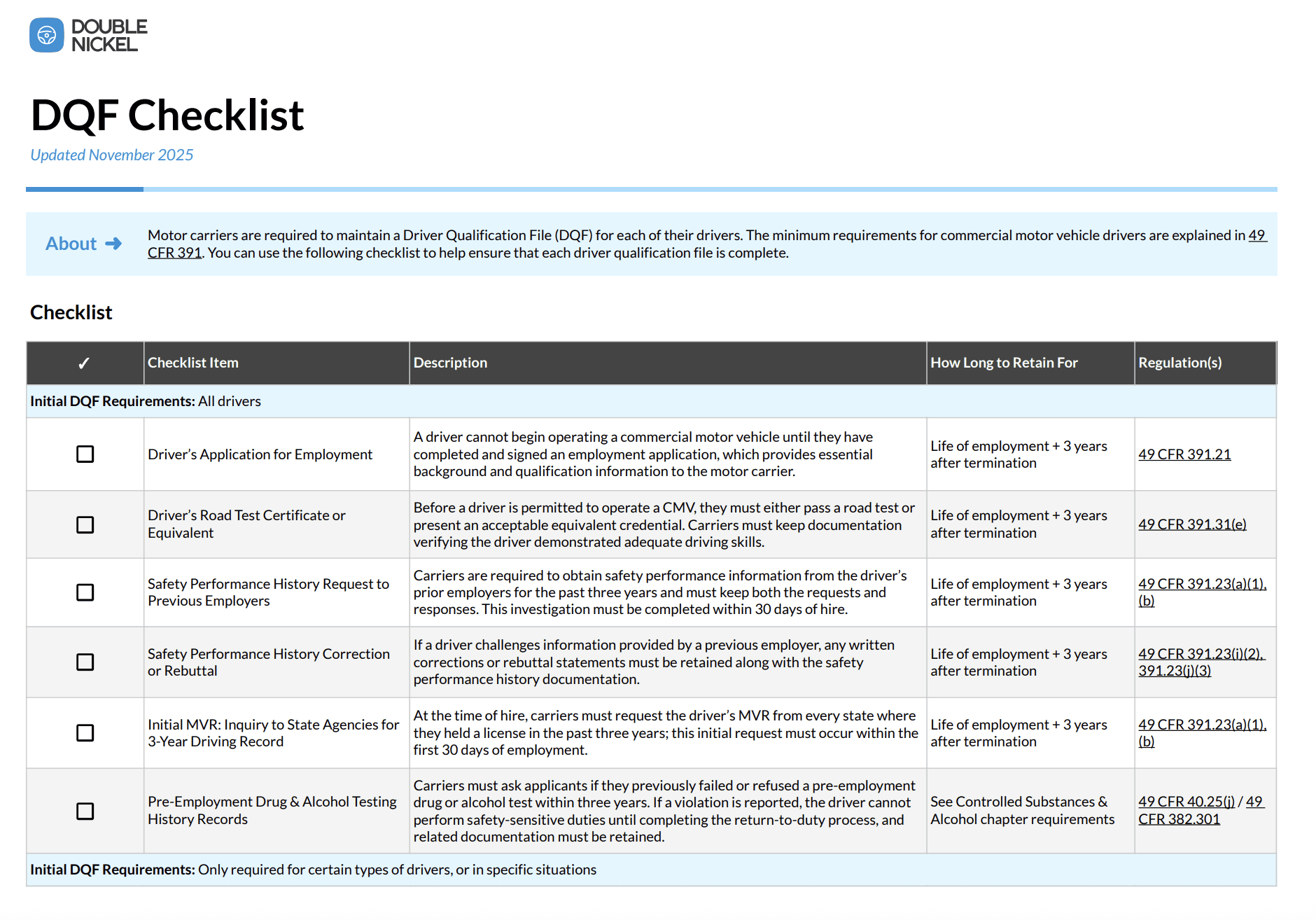
FMCSA citation for every item
Know Exactly What Belongs in Every DQF
This free Driver Qualification File checklist gives you a clear, audit-ready breakdown of required documents so you can spot gaps fast, stay compliant, and keep drivers on the road.
All Required DQF Documents
Get a complete, easy-to-follow list of everything that must be included in a Driver Qualification File, based on current FMCSA requirements.
Built for Real Fleet Workflows
Designed for recruiters, safety managers, and compliance teams, this checklist is practical, straightforward, and usable whether you manage a small fleet or hundreds of drivers.
Audit Your Files in Minutes
Use the checklist to quickly review existing driver files, identify missing or expired documents, and address issues before they turn into violations or out-of-service orders.
What goes in a driver qualification file
Motor carriers are required to maintain a Driver Qualification File (DQF) for each of their drivers. The minimum requirements for commercial motor vehicle drivers are explained in 49 CFR 391. Here’s every item in the checklist, with how long to keep it and the regulation behind it.
Initial DQF requirements: all drivers
Driver’s Application for Employment
49 CFR 391.21 · Keep for life of employment + 3 years after termination
A driver cannot begin operating a commercial motor vehicle until they have completed and signed an employment application, which provides essential background and qualification information to the motor carrier.
Driver’s Road Test Certificate or Equivalent
49 CFR 391.31(e) · Keep for life of employment + 3 years after termination
Before a driver is permitted to operate a CMV, they must either pass a road test or present an acceptable equivalent credential. Carriers must keep documentation verifying the driver demonstrated adequate driving skills.
Safety Performance History Request to Previous Employers
49 CFR 391.23(a)(1),(b) · Keep for life of employment + 3 years after termination
Carriers are required to obtain safety performance information from the driver’s prior employers for the past three years and must keep both the requests and responses. This investigation must be completed within 30 days of hire.
Safety Performance History Correction or Rebuttal
49 CFR 391.23(i)(2), 391.23(j)(3) · Keep for life of employment + 3 years after termination
If a driver challenges information provided by a previous employer, any written corrections or rebuttal statements must be retained along with the safety performance history documentation.
Initial MVR: Inquiry to State Agencies for 3-Year Driving Record
49 CFR 391.23(a)(1),(b) · Keep for life of employment + 3 years after termination
At the time of hire, carriers must request the driver’s MVR from every state where they held a license in the past three years; this initial request must occur within the first 30 days of employment.
Pre-Employment Drug & Alcohol Testing History Records
49 CFR 40.25(j) / 49 CFR 382.301 · See Controlled Substances & Alcohol chapter requirements
Carriers must ask applicants if they previously failed or refused a pre-employment drug or alcohol test within three years. If a violation is reported, the driver cannot perform safety-sensitive duties until completing the return-to-duty process, and related documentation must be retained.
Initial DQF requirements: certain drivers or situations
Entry-Level Driver Training Certificate
49 CFR 380.509(b) · Keep 3 years from date of execution
CDL drivers with less than one year of experience must document their completion of FMCSA-required entry-level driver training.
LCV Driver Training Certificate
49 CFR 380.401 · Keep for life of employment + 3 years after termination
Drivers operating Longer Combination Vehicles must provide evidence of completing LCV-specific training.
LCV Certificate of Grandfathering
49 CFR 380.111 · Keep for life of employment + 3 years after termination
Drivers who qualify for LCV operation through prior experience rather than training must provide an LCV grandfathering certificate for the qualification file.
Multiple-Employer Driver Agreement
49 CFR 391.63 · Keep for life of employment + 3 years after termination
When a driver works for multiple employers, the file must include documentation establishing which carrier is responsible for qualification and medical compliance.
Skill Performance Evaluation (SPE) Certificate
49 CFR 391.49 · Keep 3 years from date of execution
Drivers who hold an FMCSA Skill Performance Evaluation medical waiver must have a copy of the SPE certificate on file.
Ongoing DQF requirements: all drivers
Annual MVR Request: Inquiry to State Agencies for Driving Record
49 CFR 391.25(a),(c) · Keep 3 years from date of execution
Carriers must request an updated motor vehicle record annually from the state that issued the driver’s license to ensure ongoing compliance and awareness of any new violations.
Annual MVR Review
49 CFR 391.25(c)(2) · Keep 3 years from date of execution
After obtaining the annual MVR, the carrier must review it to confirm the driver remains qualified and free from disqualifying offenses, documenting the reviewer and review date.
Annual Driver Certification of Violations
49 CFR 391.27 · Keep 3 years from date of execution
Drivers must annually report any traffic convictions from the previous 12 months. Carriers must compare the report to the annual MVR for accuracy.
Medical Examination Report & Medical Examiner’s Certificate
49 CFR 391.43 · Keep 3 years from date of execution
Drivers must complete a DOT physical at least every 24 months from a certified examiner. Carriers must retain the medical certificate or CDLIS record confirming medical qualification.
Employer Verification of Medical Examiner’s National Registry Status
49 CFR 391.51(b)(9)(i–ii) · Keep 3 years from date of execution
Carriers must document that the medical examiner who conducted the driver’s physical appears on the National Registry of Certified Medical Examiners.
Checklist updated November 2025. It’s a guide to the FMCSA minimums, not legal advice; check the current regulations for your operation.