Driver Recruiting 101 - Best Practices & Tips

Learn how to build a faster, more efficient driver recruiting process with this practical guide designed for today’s highly competitive trucking market. Discover proven daily workflows and best practices that help fleets respond quickly to driver leads, move applicants through the pipeline, and hire quality CDL drivers faster.

Faster follow-up

Better pipeline

More hires
Morning to end-of-day workflow

Build a Faster, More Efficient Driver Recruiting Process

Learn how to win in today’s competitive trucking market with a practical guide built around proven daily workflows. Respond faster to driver leads, keep applicants moving through the pipeline, and hire quality CDL drivers sooner.

What’s inside the Driver Recruiting 101 guide

Each chapter has a framework you can use the same day and practical tips, plus a one-page summary of the full process.

1. Daily Workflow: Organize Your Day for Maximum Efficiency

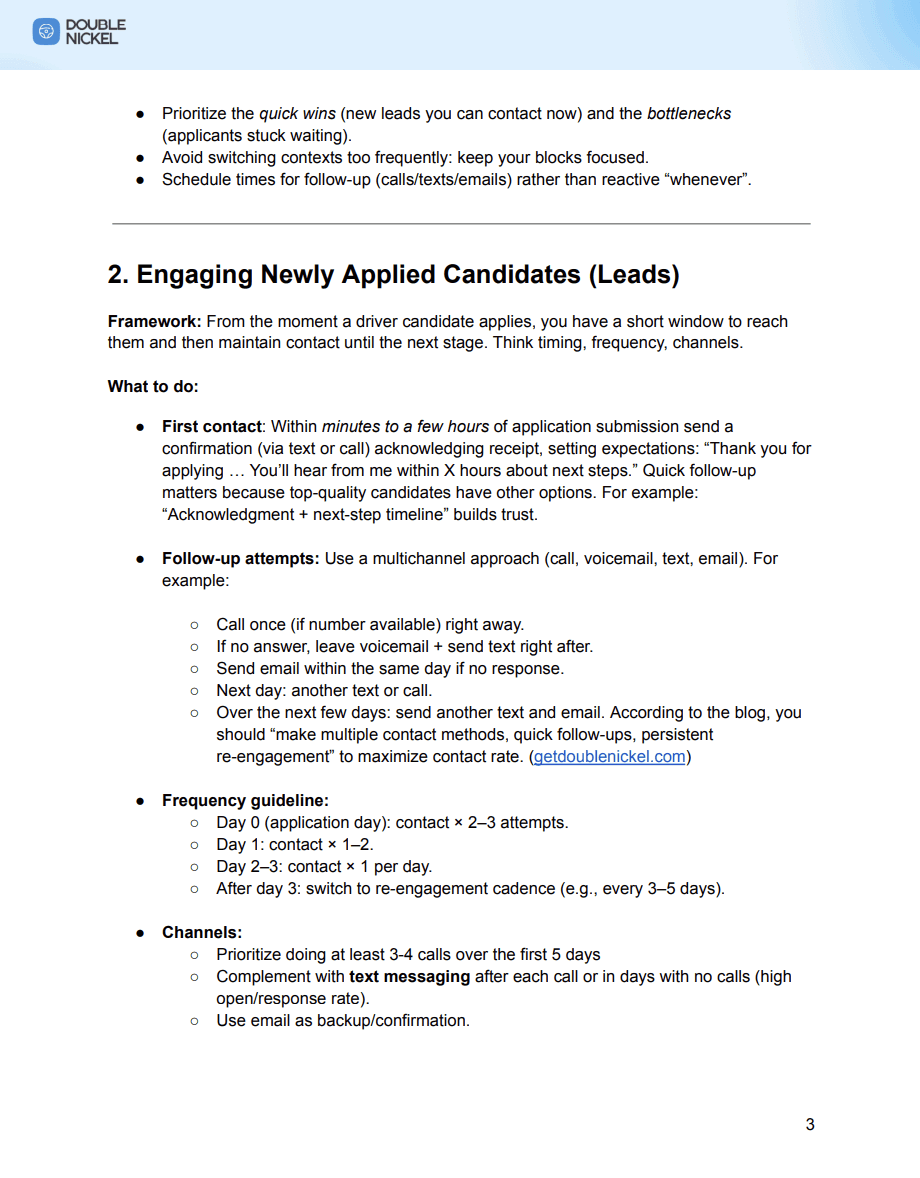
Split your day into blocks focused on different types of activity: new leads, processing current applicants, and onboarding/handoff.

2. Engaging Newly Applied Candidates (Leads)

From the moment a driver candidate applies, you have a short window to reach them and then maintain contact until the next stage. Think timing, frequency, channels.

3. Keeping Candidates Engaged Through the Process

Once a driver candidate is in process (screening, qualification, documentation), your job is to maintain momentum so they don’t drop out or accept another offer.

4. Pipeline & Status Management: Stay Organized

Good recruiters stay organized not by memory, but by structured statuses and notes, so nothing falls through the cracks.

5. Onboarding & Handoff: Smooth Transition to Hire

Once a candidate is approved and moving into onboarding, the goal is to make the transition seamless: minimize frustrations, speed time to productivity, and reinforce their decision.

6. Continuous Improvement & Metrics

What gets measured gets improved. Regularly review your performance and refine your process.
Ready to Speed Up Your Driver Recruiting?

See how Double Nickel helps you reduce drop-offs, stay compliant, and hire faster with fewer clicks.

Common Questions About the Driver Recruiting Guide

Driver Recruiting 101 is a practical guide that helps trucking fleets build a faster and more efficient recruiting process. It includes proven daily workflows and best practices designed for today’s competitive trucking market.

This guide is designed for trucking companies and fleet recruiting teams that want to improve lead follow-up, move applicants through the hiring pipeline more efficiently, and hire qualified CDL drivers faster.

The guide focuses on: Faster lead follow-up routines Pipeline management best practices Screening and scheduling workflows Improving quality and speed of CDL driver hires

Fast follow-up reduces the chances of losing qualified drivers to competing fleets. The guide provides simple daily routines to ensure recruiters respond quickly and consistently to new applicants.

It outlines best practices that reduce delays in each stage of the hiring process, helping applicants move smoothly from initial interest to final hire.

The guide is available as a downloadable resource on the page. Simply click “Download the guide” to get immediate access.

Make 2–3 contact attempts on the day they apply, 1–2 the next day, and 1 per day on days 2–3. After day 3, switch to a re-engagement cadence, such as every 3–5 days. Prioritize at least 3–4 calls over the first 5 days, with a text after each call.

Split the day into blocks: the first 60–90 minutes on new incoming candidates, a mid-day block on applications already in process, an afternoon block on onboarding and handoff, and a 15–30 minute wrap-up to update statuses and set tomorrow's priorities.