AI, Speed, and Gen Z: What's Changing in CDL Driver Recruiting
4 min
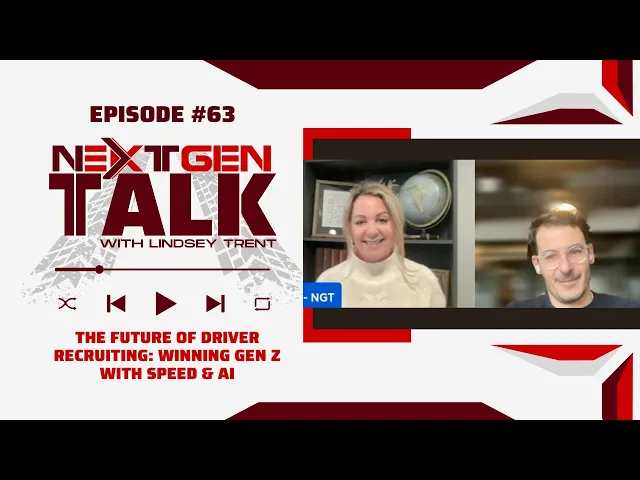
Double Nickel CEO Francisco López Roualdes joined Lindsey Trent on NGT Talks to discuss AI in CDL driver recruiting, speed to lead, and what Gen Z drivers expect from trucking fleets. "Recruiting is an operational challenge," he said. "Without drivers you cannot fill your trucks, and without the trucks you cannot serve your customers. It's tied one-to-one to revenue." Here are the key takeaways.
Empty trucks are a revenue problem, not an HR problem
Every unfilled seat is a direct hit to the business. When a truck sits idle waiting for a backfill, that's lost revenue on top of the cost of hiring the next driver.
And that cost is higher than most fleets realize. Fully loaded — advertising, recruiter salaries, background checks, MVRs, drug tests, orientation logistics — hiring a single CDL driver runs between $4,000 and $10,000. For OTR fleets running 70 to 100% annual turnover on a fleet of 200 trucks, that's one of the largest non-operational costs a carrier faces.
Driver recruiting efficiency isn't a nice-to-have. For many fleets, it's one of the highest-leverage places to improve the business.
Most of a recruiter's day has nothing to do with recruiting
Recruiters come in Monday morning with 40 or 50 leads in the queue. The driver who applied Saturday afternoon has already moved on. Half the calls go to voicemail. The other half are people who aren't qualified or aren't interested.
Recruiters spend 30 to 50% of their time just trying to reach people who showed interest: leaving voicemails, sending follow-up texts, chasing employment verifications. The work they're actually good at — building relationships with drivers and getting them excited about the job — is maybe 20% of what fills their day.
"For the recruiter, their passion is getting drivers through the finish line," Francisco said. "That's 20% of the work today. 80% is admin steps and manual tasks to get that driver into a seat."
That's the gap AI is built to close. Not to replace recruiters, but to take repetitive, time-sensitive outreach off their plate so they can spend more time on the conversations that actually move drivers forward.
Drivers pick whoever calls first
At a recent industry conference, a panel of recruiting executives from large fleets shared something worth sitting with: when drivers are asked why they chose a particular carrier, 90% of the time the answer is the same. You were the first to call, and the quickest to make an offer.
Not the best pay package. Not the best benefits. First and fastest.
"They're all very proud of their pay package and their benefits," Francisco recalled from the panel. "But they were also very realistic and said: when we ask our drivers why did you pick us, 90% of the time they say you were the first one to call me and the quickest to an offer."
Double Nickel's AI Virtual Recruiter addresses this directly. When a driver submits interest, the agent reaches out immediately by text and phone call, while the lead is still warm. It walks the driver through pre-screening questions, answers questions about the job, and either connects them to a live recruiter or schedules a callback. Some fleets using this approach are seeing 80% connect rates on that first outreach.
A fleet operating with one recruiter can now respond with the speed of a carrier that has a 24/7 call center.
Gen Z drivers have a completely different baseline for what a good hiring process looks like
Younger drivers entering the workforce have applied for jobs on their phones in two minutes, received same-day responses, completed video interviews from home, and gotten digital offer letters — all within a few days. That's their reference point for a normal hiring experience.
When they encounter a trucking company asking them to fill out a paper application, or demanding a full DOT app with every address they've ever lived at before anyone has told them anything interesting about the job, they disengage. And they don't tell you why.
"As an industry, we've gotten to normalize something that is not normal," Francisco said. "Before we have a first call and you get me excited, I'm not going to give you consent to run a criminal background check on me. That's not normal."
What this generation expects instead is responsiveness, transparency, and a process that earns their trust before demanding their information. They'll check Glassdoor, Indeed ratings, and Google reviews before or during that first conversation. A great recruiter can't overcome a pattern of bad reviews.
Moving fast and being thorough don't have to be a tradeoff
With nuclear verdicts increasingly in the news, many carriers have built triple-check processes into their driver qualification review. The recruiter reviews the DQ file, passes it to safety, and then it gets reviewed again at orientation. Each checkpoint adds time and cost.
AI can review a driver qualification file and flag anything that doesn't meet criteria consistently, every time, without the risk of a distracted or overloaded reviewer missing something.
"AI never had a bad night of sleep," Francisco said. "It doesn't have other worries in its head. For everything that has to do with backend processing, it has the ability to eliminate human error and speed up a process that used to be a tradeoff: do we move quickly and take risks, or move slowly and be thorough? AI can make that tradeoff disappear."
AI levels the playing field for smaller fleets
Large carriers already have the infrastructure: call centers open on weekends, large recruiting teams, resources to respond quickly at any hour. What AI does is give smaller and mid-sized fleets access to that same capability at a fraction of the cost.
"People think this would make mega carriers have more of an advantage," Francisco said. "I think it's quite the opposite. AI has the opportunity to bring smaller fleets the resources to move as quickly as some of the larger carriers."
A 50-truck fleet can now have a driver outreach system that responds immediately, qualifies leads overnight, and schedules calls for Monday morning before a recruiter even logs in. In a market where speed to lead is often the deciding factor, that's a real competitive advantage.
Recruiting is really a turnover problem
Most fleets treat recruiting as an inbound funnel problem. Francisco pushed back on that framing in his closing point: most attrition happens in the first 90 to 120 days, which means a lot of what looks like a hiring problem is really an onboarding and retention problem.
"Recruiting ends when the driver shows up for orientation and accepts the offer letter," he said. "That's where most of the investment stops, but it's also where most of the turnover begins."
Fleets with low turnover have a fundamentally different recruiting experience. They're hiring drivers to start six weeks out, not scrambling to backfill empty seats. That gives them more time to vet candidates, which leads to better fit, which leads to lower turnover. The flywheel works both directions.
Listen to the full episode
You can find the full conversation on Apple Podcasts, Spotify, Amazon Music, and all major podcast platforms, or watch it on YouTube.
Listen to the episode · Watch on YouTube
If any of this sounds familiar, book an intro call and we'll walk through what driver recruiting with AI looks like in practice.